


This is part of our sofa reupholstery series. Haven't chosen your fabric yet? Read the complete guide to sofa upholstery fabrics.
A standard three-seat sofa 180–200 cm long requires 10–14 linear meters of fabric at 140 cm width. A two-seater takes 7–10 meters, a sectional 15–25 meters. Always add 10–15% to your base calculation for waste and fitting — 20% if the fabric has a pattern repeat. Below is a full table by sofa type and an explanation of how the numbers work.
Fabric yardage by sofa type
Fabric width: 140 cm (standard roll). Figures include a 10% allowance for seams and fitting.
| Sofa type | Size | Plain fabric | Patterned fabric |
| Two-seater | up to 160 cm | 7–10 m | 9–12 m |
| Three-seater (standard) | 160–200 cm | 10–14 m | 12–17 m |
| Three-seater (large) | 200–240 cm | 13–16 m | 16–20 m |
| U-shaped sectional | — | 18–25 m | 22–30 m |
| L-shaped sectional | — | 15–20 m | 18–24 m |
| Sofa bed (pull-out) | 160–200 cm | 12–16 m | 15–19 m |
| Armchair | — | 4–6 m | 5–7 m |
| Square ottoman | — | 1.5–2.5 m | 2–3 m |
These are estimates. Exact yardage is calculated by the craftsman after inspecting the specific piece.
How yardage is calculated
Upholstery fabric comes on rolls. Standard width is 140–160 cm, occasionally 120 or 180 cm. Yardage is measured in linear meters along the roll — not square meters. This matters: when you order 12 meters of 140 cm fabric, you're getting a strip 12 meters long and 1.4 meters wide.
The craftsman lays out the cover panels across this strip. The wider the fabric, the more efficient the layout, the less waste, and the fewer meters needed. That's why 150 cm fabric is a better deal than 140 cm at the same price per meter.
What goes into the total yardage
A sofa has several distinct zones, each requiring fabric: the seat (cushions or a single base), the back (inside and outside faces), both armrests (each with multiple panels), side panels, front rails, and a skirt or bottom trim if present. On top of that come allowances for seams, staple overlaps, and cutting margins.
On a simple straight three-seater, this adds up to 10–12 meters. On the same length sofa with curved armrests, tufting, and welting — 13–16 meters.
Pattern repeat — why patterned fabric needs more
Pattern repeat is the length of one complete design cycle. If a fabric has a large geometric motif that repeats every 30 cm, the repeat is 30 cm. When cutting panels, the craftsman has to match the pattern across every seam: the back must visually continue from the seat, both armrests must be symmetrical.
This means part of every cut goes to waste — because the next panel can't start where the last one ended; it has to start at the beginning of a new repeat. The larger the pattern, the more fabric is lost in cutting.
How much extra to add for pattern repeat
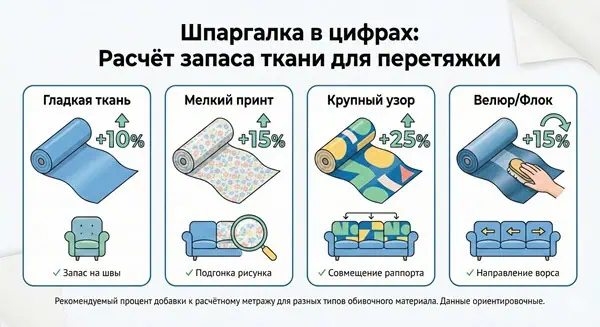
- Plain fabric or small pattern (repeat under 5 cm) — add 10%, use the base figures from the table above
- Medium pattern (repeat 5–20 cm) — add 15–20%
- Large pattern (repeat over 20 cm) — add 20–25%
- Directional pile (velvet, flock) — all panels must run in the same direction; add 10–15% even with no pattern
Pile direction is its own thing. On velvet and flock, the pile reflects light differently depending on which way it runs. If some panels end up cut against the pile, the finished sofa will show patches of a different shade. That's not a fabric defect — it's a cutting error. Any experienced upholsterer accounts for pile direction as a matter of course.
Why you can't top up from a different dye lot
This is one of the most expensive mistakes in reupholstery. Even the same SKU from the same manufacturer can vary slightly in colour between production runs — different dye baths produce subtly different results. The difference is invisible on a swatch. On a finished sofa where one cushion came from the first batch and the next from a second batch, it's obvious.
The rule is simple: all the fabric for one sofa has to come from one roll, one dye lot. If the fabric has sold out, you need to find a replacement entirely — not top up.
That's why experienced craftsmen always order with a buffer rather than cutting it close. An extra half-meter costs a fraction of what a redo costs.
Fabric width and how it affects the calculation
Most upholstery fabrics come in 140 or 150 cm widths. You'll also find 120 cm rolls (budget import fabrics) and 180 cm rolls (some performance fabrics and faux leather). All figures in the table above are based on 140 cm width.
If your fabric is wider or narrower, the adjustment is straightforward:
- 150 cm fabric — reduce the calculated yardage by 5–7%
- 120 cm fabric — increase by 15–20%
- 180 cm fabric — reduce by 20–25%
Cushions — included or separate
It depends on the construction. If the sofa has removable cushions with separate covers, they're usually included in the overall calculation. If you want to reupholster only the frame and keep the original cushions, the yardage will be noticeably lower.
Three standard removable back cushions (60×60 cm) add roughly 2–3 meters to the total. Seat cushions add another 2–3 meters. Clarify this with your craftsman before any numbers are finalized.
A practical checklist: how to get the yardage right
- Identify your sofa type and size — use the table above as your starting point
- Check the fabric width — if it's not 140 cm, adjust accordingly
- Measure the pattern repeat — add the appropriate percentage
- Confirm with your craftsman whether removable cushions are included in the estimate
- Order all the fabric from one roll — never split the order across two deliveries
- Keep the offcuts until the job is fully done — they may be needed for corrections
Frequently asked questions
How much fabric do I need for a three-seat sofa?
A standard three-seater 160–200 cm long takes 10–14 linear meters of 140 cm fabric. For a large-pattern fabric, add 20% — that's 12–17 meters. Your craftsman will give you an exact figure after seeing the sofa.
How much fabric do I need for a sectional sofa?
An L-shaped sectional takes 15–20 meters of plain fabric; a U-shaped one takes 18–25 meters. Add 20–25% for patterned fabric. Sectionals are more demanding to cut: lots of seams and corner joints that all need to match up.
What is pattern repeat and why does it matter?
Pattern repeat is the length of one full design cycle on the fabric. When cutting panels, the craftsman has to match the pattern at every seam, which means some fabric goes to waste at each cut. The larger the repeat, the more waste. For plain fabrics or a repeat under 5 cm, this factor is negligible.
Can I buy more fabric if I run short?
Only from the same dye lot — and only if that lot is still in stock. The same SKU from a different production run can be a slightly different colour, and on the finished sofa it will show. Order with a buffer from the start rather than risk this problem mid-job.
Does fabric width affect how much I need?
Yes, directly. The standard is 140–150 cm. Fabric at 120 cm requires 15–20% more yardage. Fabric at 180 cm requires 20–25% less. All figures in the table are based on 140 cm width.
Do I need to calculate cushion fabric separately?
If the cushions are removable, check with your craftsman whether they're included in the estimate. Three standard back cushions at 60×60 cm add 2–3 meters. If you're reupholstering the frame only and keeping the original cushions, your total yardage will be meaningfully lower.
What should I do with leftover fabric after the job?
Hold onto it until the work is complete and the warranty period has passed. A small piece from the same dye lot is your insurance for any local repairs down the line — especially useful in homes with pets.
Three rules that prevent problems
Order all your fabric from one roll — never split it across two orders. Always add a buffer: 10% for plain fabric, 20% for patterned. And let your craftsman see the sofa before you finalize the numbers — the table gives you a ballpark, an actual inspection gives you the real figure.
If you want to estimate the cost of reupholstering your sofa — send photos and dimensions via WhatsApp and we'll work out the yardage and pricing together, free of charge.
