


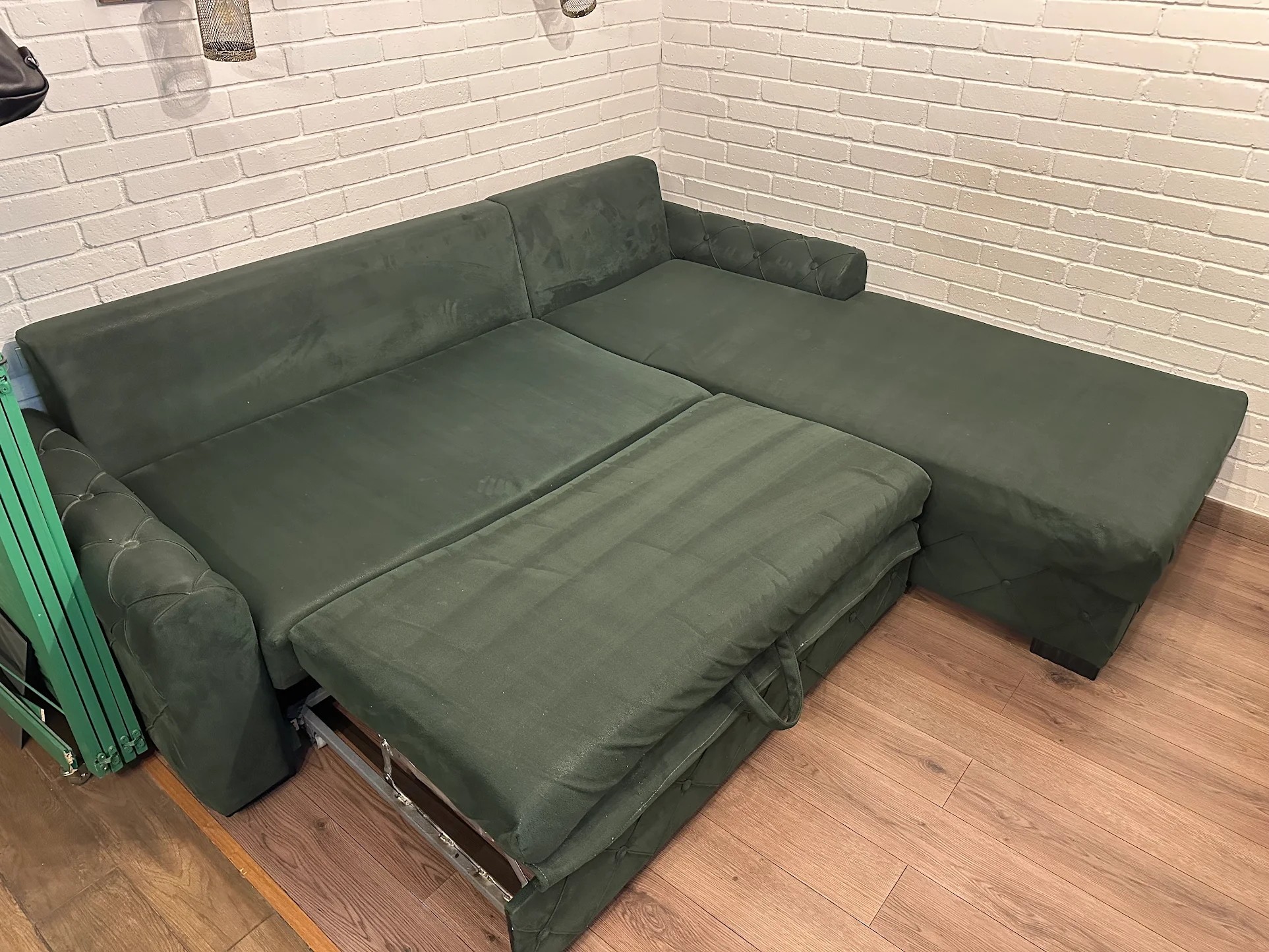
This is part of our sofa reupholstery series. Choosing fabric? Read the complete guide to sofa upholstery fabrics.
Sofa reupholstery costs what it costs because it's not a slipcover swap — it's a complete manual disassembly, custom pattern-cutting from the removed pieces, and a full rebuild from scratch. Every sofa is different. There are no templates, no production line. Here's an honest breakdown of where the money actually goes.
Why reupholstery feels expensive
The most common thing upholsterers hear: "But it's just fabric and labor — why so much?" The question makes sense, because from the outside a reupholstery job looks simple. You take a worn sofa, put new fabric on it, done. What's actually happening is a complete manufacturing process, done by hand, once, for one specific sofa.
To understand the cost, you need to compare how a sofa gets made in a factory versus what a craftsman does when reupholstering one.
Factory vs. craftsman: a fundamental difference
How a sofa is made at the factory
A factory runs on volume and repetition. There are engineering drawings, standardized templates, and an automated cutting machine that processes dozens of meters of fabric in a single pass. Seamstresses sew the same panels hundreds of times — the movements become automatic, speed is maximized, waste is minimized. The frame is assembled from standardized components. Padding goes in according to a spec sheet. The finished cover is stretched over the assembled frame and fixed with a staple gun.
The entire process is optimized for speed and replication. One sofa on a production line is part of a run of hundreds of identical sofas.
What actually happens during reupholstery
The craftsman receives a sofa that's already been assembled — assembled the way the factory found convenient, not the way that makes it easy to take apart. Most modern sofas aren't designed with repairability in mind: fasteners are hidden, fabric is stapled in inaccessible spots, and some sections can only be reached by partially dismantling the whole structure.
Reupholstery doesn't begin with new fabric. It begins with disassembly. And that's the first cost that most clients never think about.
What you're actually paying for
Disassembly — the work nobody sees
Before the craftsman touches a single piece of new fabric, he has to get to the old one. That means removing cushions, detaching back panels, taking apart armrests, carefully pulling out staples without damaging the frame or tearing the padding. On complex sofas — sectionals, sofa beds, pieces with decorative detailing — disassembly alone can take several hours.
Some sofas can't be accessed at the base without essentially stripping the whole structure down to the frame. Who pays for those hours? They're built into the reupholstery price. You just don't see them because the finished result looks like a brand new sofa.
Pattern-making — every sofa has its own shape
At the factory, templates are drawn once and used thousands of times. For a craftsman, every sofa is a unique object. Even two sofas of the same model, bought from the same store, can have slight differences in armrest shape or back height.
Once the old upholstery is removed, the pieces become the patterns for the new fabric. The seamstress doesn't start from existing templates — she starts from what came off the sofa. Each piece has to be laid out correctly on the new fabric, accounting for pile direction or pattern repeat, with seam allowances calculated by hand. That takes time, and time costs money.
Sewing — not a production run
A factory seamstress sews the same panel all day. Her hands know exactly what to do, speed is high, mistakes are rare from sheer repetition. A seamstress making a cover for one specific sofa is doing it for the first and last time. Every seam is a new decision. Every corner is a manual adjustment.
Complex shapes — curved armrests, sculpted backs, tufted buttons, welting — take significantly more time than simple geometric pieces. That's why unusual or ornate sofas cost more to reupholster than straightforward ones.
Sourcing the fabric
Clients often assume fabric selection is just picking from a catalog. In practice, finding the right material in the right color, width, and quantity — and actually having it in stock — takes real effort. One fabric is sold out. Another only comes in rolls of 20 meters when you need 12. A third arrives with a defect. This process is invisible to the client, but it's part of the work.
Reassembly — everything goes back in order
Once the new upholstery is sewn, the sofa has to be put back together. In the right sequence, with proper tension, no wrinkles, no misalignment. The padding has to sit evenly, the mechanism has to work, the armrests have to be solid. That's several more hours of work.
And if disassembly revealed a deformed spring or a sagging strap — that's additional work that wasn't visible until the sofa was opened up.
Why you can't get an exact price from a photo
The second most common frustration: "I sent a photo — why can't you just give me a price right now?" The answer is straightforward: a photo shows the exterior, not the construction.
Two sofas that look identical can differ enormously in the amount of work involved:
- One disassembles in an hour, the other takes four — because the armrest attachment is non-standard
- One has a simple rectangular back, the other has a sculpted back with tufting and piping
- One sits on a wooden frame, the other on a metal one, which requires completely different attachment methods
- One has padding in good shape, the other has foam that's disintegrated and needs replacing
All of this becomes clear during inspection or disassembly. A craftsman who quotes an exact price from a photo is either very experienced and building in a large buffer — or will add charges for "unexpected" work later.
Reupholstery prices in Tbilisi
For context: a mid-range new sofa in Tbilisi costs 1,200–2,500 GEL. Reupholstery is usually considerably less, and a well-reupholstered sofa on a solid frame will last another 5–7 years. Labor costs only:
- Simple two-seat sofa, straight lines, no mechanism — from 500 GEL
- Standard three-seat sofa — 600–800 GEL
- Sectional sofa — from 900 GEL, depending on size and configuration
- Sofa bed with pull-out mechanism — add 80–150 GEL to the base price
- Padding replacement (foam, fiberfill) — priced separately, typically 50–150 GEL
- Spring or strap replacement — priced separately, depends on extent
Fabric is on top of labor. At 10–14 linear meters for a three-seat sofa and $8–65 per meter (22–179 GEL), fabric adds another 220–2,500 GEL depending on your choice of material.
All-in for a standard three-seat sofa: from around 820 GEL for a basic fabric to 3,300+ GEL for premium materials. A new sofa of comparable quality starts at 1,200 GEL — and unlike a new sofa, a reupholstered piece usually has a better frame.
We give free preliminary estimates from photos via WhatsApp and Telegram within 15 minutes — see how it works.
When reupholstering makes sense — and when it doesn't
A simple test based on the real numbers:
- Solid hardwood frame, springs in good shape — reupholstering is almost always the better call. The sofa will give you another decade of use and end up better than most new pieces at the same price point.
- Particleboard frame, deformed springs — run the numbers. Labor plus fabric plus spring replacement can approach the cost of a new equivalent sofa. In that case, buying new often makes more financial sense.
- A piece with history or genuine antique value — money isn't really the question. You can't replace it with something from a showroom floor.
A quick way to check the frame yourself: grab both armrests and push and pull. There should be zero movement and zero creaking. Any wobble is a signal that the frame has already seen better days.
What drives the final price: the short version
- Sofa shape — straight lines are cheaper, curves and sculpted forms take more time
- Pull-out mechanism — sofa beds are more complex to disassemble and reassemble
- Padding condition — if the foam has broken down, replacement adds to the cost
- Spring condition — deformed springs are replaced at an additional charge
- Fabric choice — price range from $8 to $65+ per meter
- Pattern repeat — fabric with a repeating design requires extra yardage and more careful cutting
- Decorative details — tufting, piping, contrast stitching all add to the labor cost
Frequently asked questions
Why does sofa reupholstery cost so much?
Because it isn't "just putting on new fabric." The craftsman fully disassembles the sofa, the seamstress creates custom patterns from the removed pieces and sews a one-off cover — no templates, no production line — and then everything is reassembled. A factory builds a sofa from standardized components on a production run. Reupholstery is bespoke handwork, done once, for one specific sofa.
Why can't you quote a price from a photo?
A photo shows the outside, not the construction. Two sofas that look the same can differ by two or three times in labor — because of hidden fasteners, padding condition, spring damage, or the shape of the armrests. A firm price comes after inspection, not before.
What's included in the reupholstery price?
The craftsman's labor for disassembly, pattern work, and reassembly — plus the seamstress's work to sew the new cover. Fabric, padding replacement, and spring repair are quoted separately. Always clarify what's included in any price you're given before work begins.
Is it cheaper to just stretch new fabric over the old?
For very simple structures, occasionally. In practice, it's a bad idea: the old fabric underneath continues to compress and deform, the new fabric will sit unevenly, and tension will be inconsistent. Within a year or two the result looks worse than if you'd done it properly in the first place.
How long does a reupholstery job take?
From one week to a month — accounting for scheduling, fabric sourcing and delivery, and sewing time. If the fabric is already chosen and in stock, the actual work on a standard three-seat sofa takes 2–4 working days.
Reupholster or buy new — how do I decide?
If the frame is solid hardwood with no spring issues — reupholstering is almost certainly the better value. If it's particleboard with deformed springs, add up all the costs and compare honestly to a new sofa. For more on this, see our full fabric guide.
The bottom line
The price of reupholstery isn't markup — it's payment for skilled manual labor: dismantling someone else's work, making patterns that don't exist anywhere, sewing without templates, and putting everything back together correctly. A factory builds a sofa once on a conveyor belt. A craftsman rebuilds it by hand, from scratch, for your specific piece.
If you want to know what your sofa would cost to reupholster — send us a photo and describe the piece. We'll give you a real number, no hidden additions.
