


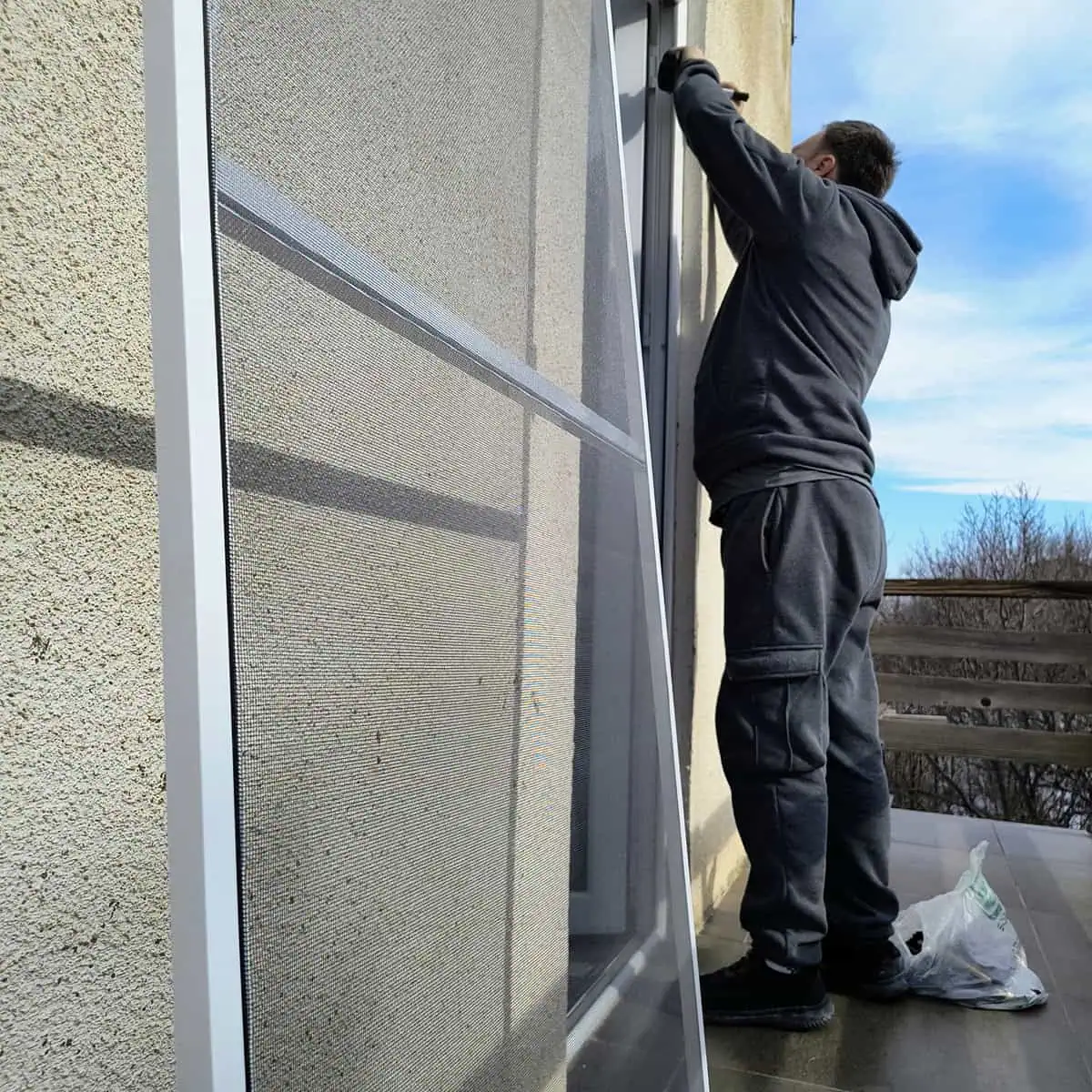
A window screen is not a safety device. It's not designed to hold weight — it's designed to keep insects out, and it will pop out of the frame the moment a child leans against it. The WHO lists falls as the sixth leading cause of death in children worldwide and specifically flags windows in multi-storey buildings as a distinct risk factor. In the US alone, between 3,500 and 5,000 children are hospitalised each year after falling from windows — one in three requires intensive care. In Russia, the Ministry of Internal Affairs records over a thousand cases annually, more than a hundred of them fatal. This is not a regional problem: it happens wherever there are apartment buildings and open windows. The only real protection is a window restrictor. Not a screen.
Why Screens Fall Out: The Physics Nobody Explains at the Shop
A standard mosquito screen sits in a window frame held in place by light aluminium or plastic beading — no mechanical fixation, no locks, nothing. The design handles one type of load well: light perpendicular pressure from wind, dust, or insects pushing straight against the mesh.
A child leaning or falling sideways against the screen applies lateral force — a completely different direction that the mounting isn't built to resist at all. As little as 3–5 kg of sideways pressure is enough to dislodge the frame. The child goes through, and the screen falls out with them.
This is why in every documented case the screen is found intact on the ground next to the child. It didn't break — it just came out.
Standard Screen, Anti-Cat Screen, Safety Screen — Three Different Things
Many parents upgrade to a "reinforced" or "heavy-duty" screen thinking it will protect their child. Here's what that actually means in practice.
A standard mosquito screen holds around 3–5 kg of lateral load. That's not enough to stop even a one-year-old.
An anti-cat screen — thicker weave, stronger mesh — holds around 8 kg. That sounds better until you realise: any child heavier than 8 kg — which is most children from about 18 months onwards — will push straight through it. Anti-cat screens protect cats. They do not protect toddlers or young children from falling.
A purpose-built safety screen (brands like BabySafe and similar) works on an entirely different principle: it's anchored to the frame or wall with proper brackets, not slotted into a groove. Load tests show it holds over 150 kg. It lets air through and looks like a regular mosquito screen from a distance. It costs more and requires professional installation — but it's the only type of screen that will actually stop a child from falling.
If your window has a standard screen or an anti-cat screen, there is no fall protection in place. Only the third type provides it.
What the Numbers Show
The problem is neither new nor localised. The WHO's World Report on Child Injury Prevention identifies falls as the sixth most common cause of child death globally, with windows in urban apartment buildings listed as a specific risk factor.
Harborview Medical Center — the only Level I paediatric and adult trauma centre in Washington State — treats 40 to 50 children with window fall injuries every year, a figure that has stayed consistent for two decades. One in four patients leaves hospital with long-term health consequences.
New York City showed that the problem is solvable. The "Children Can't Fly" programme, launched in the 1970s, combined free window guard installation in residential buildings with mandatory requirements for landlords. The result was a sharp and sustained drop in child fatalities from window falls — an outcome now cited by paediatric organisations worldwide as proof that physical barriers work, while awareness campaigns alone do not.
Peak risk runs from April through September, when windows are opened for ventilation and children spend more time at home.
Five Devices That Actually Work
All of the options below can be fitted to an existing window — no need to replace the frame. In Tbilisi, look for them at Domino, Gorgia, or Modus hardware stores, or through the Eliyava market. If you'd rather not deal with the installation yourself, the team at CityHandyman can fit a restrictor in a single visit — it usually takes under half an hour.
- Keyed window handle — locks the window completely. Without the key, the child cannot open it at all. Most models still allow the window to be set in tilt position, so the frame stays cracked open at the top for ventilation while remaining impossible to push fully open or shut without the key. Good choice for children's rooms where adults aren't always present.
- KISI blocker (Hoppe, Rehau and similar) — mounts under the handle rose, completely hidden, no change to the window's appearance. To turn the handle, you have to press the blocker from both sides simultaneously — a two-handed action that a pre-schooler can't manage. No key needed; adults open it in a second. Older children (5–6 years) may figure it out if they've watched their parents do it.
- Cable restrictor (Penkid and similar) — lets the window open, but only as far as the steel cable allows, typically around 20 cm. Ventilation is possible. Works on casement windows, fanlights, and balcony doors. Full opening requires a key to release the cable. One of the most versatile options.
- Frame restrictor — fits into the window hardware groove and holds the frame at around 8 cm open. Releasing it requires a hex key — straightforward for an adult, impossible for a child. No visible parts on the outside. The tilt/turn ventilation mode works without restriction.
- BSL surface-mount lock — screws onto the bottom of the window sash. Prevents full opening while leaving the tilt ventilation mode available. Fits any PVC profile. From around 10–15 GEL. The most affordable and easiest to install yourself.
For a child's room, the safest approach is to combine two layers: a frame restrictor plus a handle blocker. That covers both scenarios — the child can't open the window on their own, and can't accidentally push out the screen by leaning against it.
What to Do Today — No Tools, No Installer Required
Most accidents don't happen because parents didn't know about the risk. They happen because knowing and doing are separated by a specific list of steps nobody wrote down. Here it is.
- Move furniture away from windows — beds, sofas, chairs, stools. A child who can't climb to the window can't fall from it. This takes five minutes.
- Remove the window handle and put it out of reach — a temporary fix until you buy a restrictor. Without the handle, a PVC window cannot be opened. The handle comes off with a screwdriver in about a minute.
- Buy a surface-mount lock or cable restrictor — available at Domino, Gorgia, and Eliyava market in Tbilisi, from around 10–15 GEL. Installs without drilling. Instructions included. If you'd prefer a professional to handle it, CityHandyman can do it in a single visit — typically under 30 minutes.
- Check your window's tilt mode — if the handle is turned horizontal, the window is in full-open mode and a child can fall. If the handle points straight up, the frame tilts inward from the top, leaving a gap at the top only. In tilt mode, falling out is physically impossible.
- Talk to your child — not to frighten them, but to explain: the screen isn't solid, it won't hold them. Children aged 3–5 absorb this kind of rule well when it's repeated calmly. It's not a substitute for physical protection, but it's part of a complete approach.
Can I still ventilate if I install a restrictor? Yes, depending on the type. A cable restrictor or frame restrictor lets you open the window to a safe gap — 8 to 20 cm. Most keyed handles allow the window to be locked in tilt position, so you get ventilation through the top gap without the child being able to open it further. Tilt mode itself — handle straight up — requires no additional hardware and is inherently safe.
My apartment is in a newer building — does it already have safety hardware? Check the handle: if it won't turn without pressing a secondary button, or if there's a visible stopper underneath, the safety feature is already there. If the handle turns freely, it either wasn't installed or was removed during renovation. Either way, the fix is the same: buy and fit a restrictor.
My child pushed the screen and it didn't fall — does that mean it's secure? No. Light pressure pushes against the beading in a direction it can handle. The failure happens with sudden lateral bodyweight — and it happens without warning. In every documented incident, the screen is found undamaged. It didn't break. It simply came out.
From what age can a child open a PVC window on their own? The handle on a standard PVC window turns with the force available to a child from around age 2–3. Trauma centres record the highest injury rates in children aged 18 months to 7 years — old enough to reach and open the window, not yet old enough to understand what height means.
