


A clogged sink is something everyone deals with eventually. Water stops draining, starts backing up, and you get that unpleasant smell. When your sink gets blocked, your first thought might be to call a plumber. But in most cases, you can fix it yourself in 20-30 minutes.
This article explains how to unclog a kitchen or bathroom sink, which methods actually work (and which waste your time), and when you really do need to call a professional plumber.
Why Sink Clogs Happen
The main culprit behind most sink clogs is grease. After washing dishes, a thin layer of oil coats the inside of your pipes. When temperatures drop below 40°C (104°F), it solidifies and becomes sticky. Small particles start sticking to this layer: crumbs, hair, food scraps.
Over a month or two, a solid plug forms that significantly narrows the pipe. Water starts draining slower, then stops completely.
Common clog causes:
- Cooking oil and animal fat from frying
- Coffee grounds (they don't dissolve in water)
- Hair (especially in bathroom sinks)
- Soap scum (forms when soap meets hard water)
- Food scraps, peels, and leftovers
- Flour and dough (they swell and turn into paste)
Tbilisi-Specific Challenges
In Tbilisi's older buildings, the problem gets worse due to the state of the plumbing. Most pipes were installed in the 1960s-80s. Over decades, the cast iron and steel pipes have built up mineral deposits and rust inside—the actual diameter can shrink by half.
Locating the Clog: Diagnosis
Before you start clearing the blockage, figure out exactly where it is.
Simple diagnostic steps:
- Turn on all the faucets in your apartment. If water only backs up in one sink, it's a local problem you can handle yourself. If nothing drains anywhere, the main stack is clogged and you need a specialist.
- Fill the sink completely with cold water and time how long it takes to drain:
- 1-2 minutes — minor clog
- 3-5 minutes — moderate clog
- 10+ minutes or doesn't drain — serious blockage
- Open the cabinet under the sink and watch the water flow:
- Doesn't pass through the drain opening — clog is there
- Accumulates in the trap — trap is blocked
- Passes the trap but then stops — clog is in the pipe, not at the sink
Common blockage locations:
- Drain opening — the narrowest point (40-50mm), where large particles get stuck
- P-trap under the sink — the U-shaped bend creates a water seal, but debris accumulates there
- Corrugated pipe — dirt catches in the ridges
- Pipe joints — in old buildings, connections are uneven and buildup forms
How to Clear a Clogged Sink with a Plunger
A plunger is the first thing to try when your sink won't drain. It's a simple tool that most households have.
How it works: pushing down creates pressure, pulling up creates suction. These pressure changes break up and push through the blockage.
Proper technique:
- Find the overflow hole (at the top of the sink) and plug it tightly with a wet rag. Without this step, you'll lose all effectiveness—pressure escapes through the overflow.
- Add enough water to completely submerge the rubber part of the plunger. Water does the work, not air.
- Place the plunger directly over the drain and press firmly.
- Make 15-20 sharp downward thrusts at one-second intervals. Don't lift the plunger off the sink.
- Pull up sharply.
- Run hot water for 30 seconds to test.
If the water drains—great, you're done. If not, repeat the cycle 3-4 times.
A plunger effectively clears blockages up to 50cm deep. After clearing, always flush the pipes with hot water or boiling water to wash away grease residue from the walls.
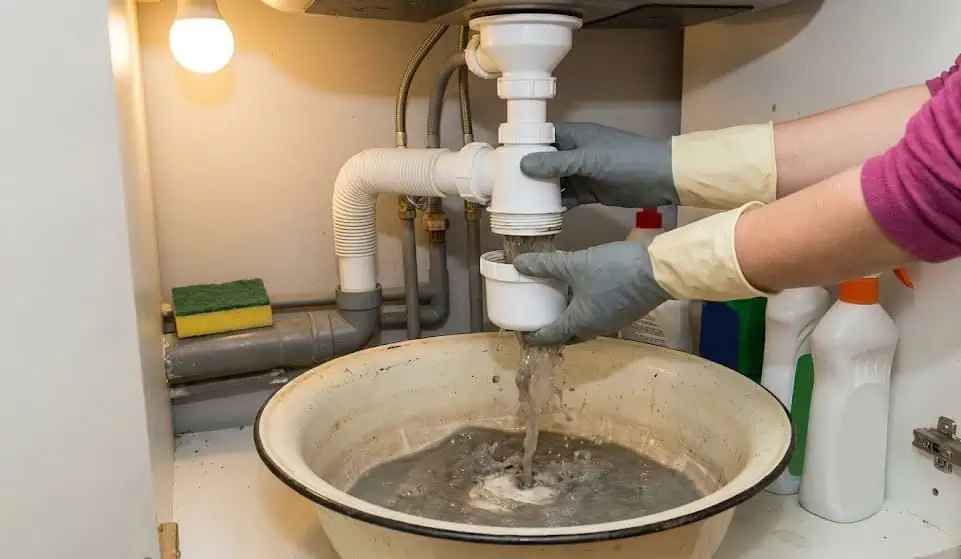
Clearing a Clog by Disassembling the P-Trap
When the plunger doesn't work, the problem is likely in the trap. You can take it apart yourself.
What you'll need:
- Basin or bucket
- Rags
- Rubber gloves
- Adjustable wrench (for old cast iron traps)
Instructions:
- Clear the space under the sink and place a basin—dirty water will pour out when you unscrew it.
- Modern plastic traps unscrew by hand (counterclockwise). Old cast iron ones need an adjustable wrench—unscrew carefully as the threads may be worn.
- Remove the contents. You'll typically find:
- Hardened brown grease
- Hair clump
- Small objects (coins, buttons)
- Food residue
- Wash the trap with hot water and dish soap. Use an old toothbrush on the inner walls. For heavy buildup, soak in a baking soda and vinegar solution for 15 minutes.
- While the trap is off, inspect the pipe in the wall. Shine a flashlight inside. If you see buildup, try reaching it with wire or a brush.
- Reinstall the trap. Check the rubber gaskets—if they're hardened (common in older homes), replace them. Gaskets cost a couple of GEL and are available at any "1000 Little Things" shop.
- Turn on the water and check for leaks. Place a dry rag underneath and watch for several minutes.
Important note: In homes with fixtures bought 10-15 years ago, gaskets often crumble when disassembled. Don't start this job on a Sunday evening when stores and Eliava or Deserter markets are closed. Buy spare gaskets beforehand.
In old Soviet-era buildings, you sometimes find cast iron traps with seized threads. If it won't budge, don't force it. Better to call a CityHandyman specialist—they'll remove it and advise on upgrading to modern fixtures.
Drain Cleaning Products
Baking Soda and Vinegar
A popular home remedy. Works through a chemical reaction that releases carbon dioxide—the foam softens grease, and the gas creates pressure.
How to use:
- Remove standing water from the sink. The drain should be dry.
- Pour 200-250g of baking soda down the drain. Push it deeper with a stick.
- Pour in 250ml of white vinegar (9%).
- Immediately plug the drain with a stopper or wet rag—the reaction needs to happen inside the pipe, not on the surface.
- Wait 30 minutes.
- Boil 2-3 liters of water and pour it down quickly in one go.
About 50% effective for light to moderate clogs. Rarely works for complete blockages.
Common mistake: mixing soda and vinegar in a container, then pouring it down. That doesn't work—the reaction happens instantly, and by the time it reaches the pipe, the mixture is inactive.
Boiling Water
The simplest method for grease clogs.
Boil at least 3 liters of water. Pour it down quickly in one motion—you need to create thermal shock and pressure. Wait 5 minutes and repeat. May take 3-4 cycles.
Important: Homes built before 1995 may have old white PVC pipes that deform from boiling water. If you're unsure, use water at 70-80°C (158-176°F).
Regular use of boiling water (1-2 times weekly) is excellent prevention.
Caustic Soda (Sodium Hydroxide)
Industrial alkali that dissolves organic matter. Available at hardware stores and Deserter Market (5-10 GEL).
Application:
- Wear rubber gloves and safety goggles—caustic soda causes chemical burns.
- Pour 2-3 tablespoons into the dry drain.
- Add a glass of boiling water (200ml). You'll see a reaction—steam and hissing.
- Leave for 20-30 minutes.
- Flush thoroughly with cold water (3-5 liters).
Limitations:
- Cannot be used in aluminum pipes
- Cannot be used with complete blockages (solution will sit there, can cause burns)
- Not more than once every 2-3 months
Highly effective (about 85%) for organic clogs.
Store-Bought Drain Cleaners
Tbilisi supermarkets (Carrefour, Goodwill) have plenty of options:
- Krot (Крот) — Russian product, 8-12 GEL, alkaline-based
- Tiret Turbo — gel formula, 20-25 GEL, more effective
- Sanfor — 14-15 GEL, mid-range
Guidelines:
- Read instructions—working time ranges from 15 minutes to 8 hours
- Never mix different products—dangerous reaction
- Ensure proper ventilation
- Don't exceed recommended dosage
Tiret works better than Krot but costs twice as much. For prevention, the budget option works; for serious clogs, go with Tiret.
If two applications don't help, stop. You need mechanical clearing.
Using a Drain Snake for Deep Clogs
When the blockage is deep in the pipe and other methods fail, use a plumber's snake. This is a flexible metal cable 3-5 meters long with a handle and spiral or hook at the end. Costs 30-50 GEL.
Procedure:
- Best to remove the trap and insert the snake through the pipe in the wall.
- Slowly push the snake in while rotating clockwise—this prevents snagging on bends.
- When you feel resistance (hit the clog), rotate the snake vigorously with back-and-forth movements.
- Once the blockage gives way, slowly pull out the snake—there may be a clump of debris on it.
- Flush the pipe thoroughly with hot water under pressure.
Important: In Tbilisi's old buildings, cast iron pipes are rough inside. Overly aggressive work can damage them. Move smoothly.
If you don't have a snake, call a professional plumber—specialists have electric snakes with cameras for precise clearing without damaging pipes.
When You Need a Professional Plumber
Some situations require professional help:
- Stack clog — water won't drain anywhere in the apartment or at neighbors'
- Old cast iron pipes — they're 50-70 years old, brittle, with seized connections
- Post-renovation clog — construction debris may have fallen in
- Leaks — wet under the sink with no obvious cause
- Recurring clogs — problem returns weekly
If water won't drain in your kitchen or bathroom sink after all DIY attempts, don't delay calling a specialist. Professional diagnosis can pinpoint the cause and prevent more serious damage to your plumbing system.
Cost of Drain Cleaning in Tbilisi
Current prices (2026):
- Service call and diagnosis: 50-100 GEL (usually included in service)
- Plunger/snake clearing: 100-200 GEL
- Trap disassembly and cleaning: from 100 GEL
- Hydro-jetting: 200-350 GEL
- Trap replacement: 100-180 GEL (labor + materials)
- Emergency evening/night call: +50-100% surcharge
For most household issues, you can call a handyman—a CityHandyman general specialist will come quickly and usually charges less than a specialized plumber.
For serious problems, it's better to contact a professional plumber with a full set of specialized equipment.
Preventing Clogs
Prevention is easier and cheaper than fixing problems.
Daily
Drain screen — a simple metal or plastic screen (2-3 GEL) catches large particles. Empty it after washing dishes.
Don't pour grease — let cooking oil cool after frying, collect it in a bottle, throw it in the trash.
Hot water rinse — run hot water for 20-30 seconds after washing dishes.
Scraps in trash — scrape food off plates before washing. Especially rice, pasta, coffee grounds, and peels.
Weekly
Once a week, boil 3-4 liters of water and pour it down the sink. This dissolves accumulated grease.
Biweekly
Preventive cleaning with baking soda and vinegar, even if everything's working fine.
Monthly
Open the cabinet under the sink and check for drips, see how quickly water drains. At the first suspicious sign, clean the trap.
Twice a Year
Spring and fall, do a thorough cleaning with commercial cleaner or caustic soda.
Annually
If your building was constructed before 1990, call a specialist for preventive inspection. They'll check pipe condition, connections, and slope. Inexpensive and can prevent serious problems.
Tbilisi Specifics
Hard water — use cleaning products designed for hard water. Do an acid flush every 2-3 months.
Old buildings — be careful with aggressive chemicals. Do prevention more often—boiling water twice weekly.
Water interruptions — after prolonged outages, let water run 5-10 minutes (initial water is dirty), then flush with boiling water.
What Doesn't Work
Coca-Cola — acid concentration is too low. You'd need 10-15 liters and 24 hours of waiting.
Laundry detergent — creates lots of foam, little effect.
Vacuum cleaner — dangerous. Water can get inside, ruin the appliance, and cause electric shock.
Wire coat hanger — too thin, gets stuck, scratches enamel, damages old pipes.
Mixing chemicals — absolutely never! Acid + alkali = dangerous reaction with heat and gas release.
Frequently Asked Questions
What should I do if my kitchen sink is clogged?
Start with a plunger—70% of the time this solves the problem in 5-10 minutes. If that doesn't work, try pouring boiling water (3 liters in one quick pour), then baking soda and vinegar. If still no results, disassemble and clean the trap. If all methods fail, call a plumber.
How do you unclog a sink at home?
The most effective home methods: boiling water (for grease), baking soda and vinegar (200g soda + 250ml vinegar, plug for 30 minutes), plunger (creates pressure changes). For stubborn clogs, use commercial cleaners like Tiret or caustic soda, or mechanical clearing with a plumber's snake.
How much does drain cleaning cost in Tbilisi?
2026 prices: specialist call 50-100 GEL, standard plunger or snake clearing 100-200 GEL, trap disassembly from 100 GEL, hydro-jetting 200-350 GEL. Emergency evening or night calls cost 50-100% more. A handyman is usually cheaper than a specialized plumber.
How often should I clean my sink drain for prevention?
Daily: rinse with hot water 20-30 seconds after washing dishes, use a drain screen. Weekly: pour 3-4 liters of boiling water. Biweekly: preventive cleaning with baking soda and vinegar. Monthly: check the trap. Twice yearly: thorough cleaning with chemical cleaner.
When should I call a plumber?
Definitely call a specialist if: water won't drain anywhere in the apartment (stack clog), building is 50+ years old with cast iron pipes (high damage risk), clog after renovation (construction debris), leaks under sink, problem returns weekly despite clearing. Also if 2-3 methods haven't worked—don't keep experimenting.
Does baking soda and vinegar really work for clogs?
Yes, but only about 50% effective for light to moderate clogs. Must be done correctly: pour 200-250g soda into dry drain, add 250ml vinegar (9%), immediately plug with stopper (reaction must happen inside pipe), wait 30 minutes, flush with boiling water. Ineffective for complete blockages—needs mechanical clearing or chemicals.
Can I use boiling water to clear drains?
Yes, boiling water is effective against grease clogs. Boil at least 3 liters, pour quickly directly into drain in one motion. Repeat 3-4 times at 5-minute intervals. Caution: homes built before 1995 may have old white PVC pipes that deform from boiling water—use 70-80°C (158-176°F) water instead. Regular boiling water 1-2 times weekly is excellent prevention.
Key Takeaways
Step-by-step approach: Start simple: boiling water → plunger → baking soda and vinegar → trap disassembly → chemicals → snake → professional.
Prevention works: Drain screen, weekly boiling water, proper grease disposal reduce clog likelihood several times over.
Know your limits: If 2-3 methods haven't worked, call a professional. Persistence can damage pipes.
Consider building age: In pre-1990 buildings, be more careful with aggressive methods.
